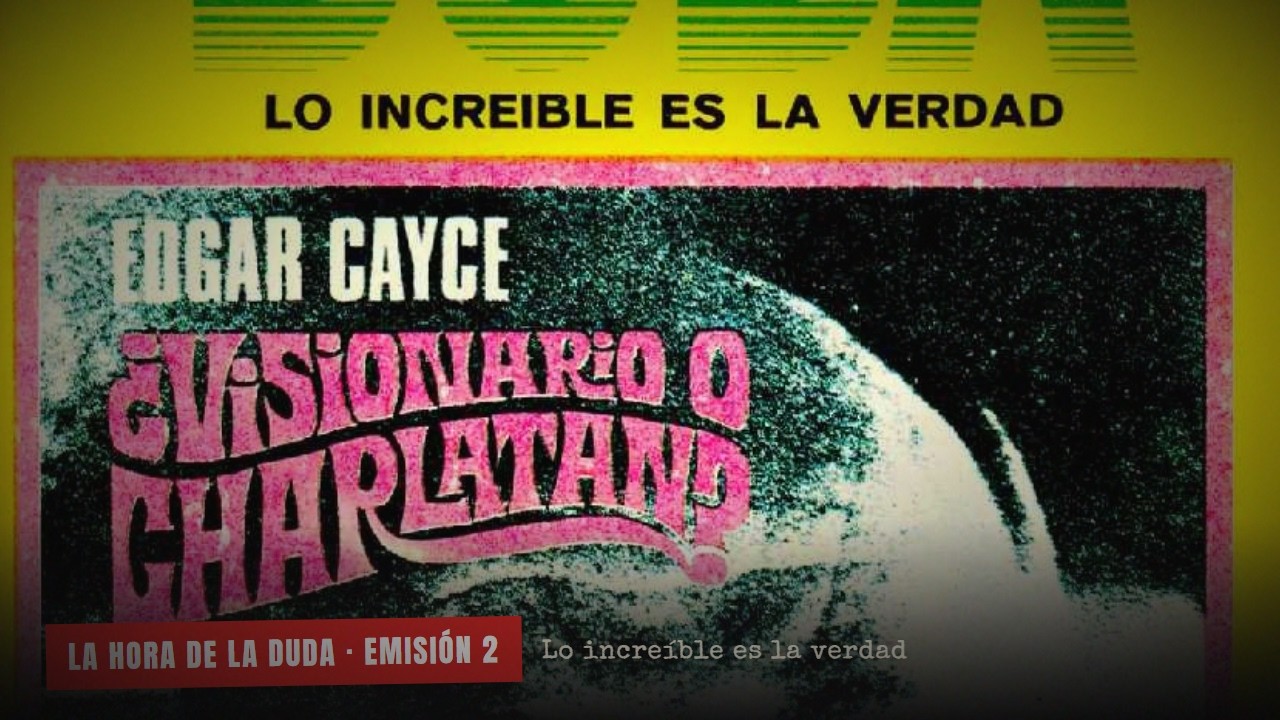
In the annals of paranormal history, few figures spark as much debate as Edgar Cayce. Born in 1877, this unassuming man from Hopkinsville, Kentucky, became known as the "sleeping prophet" for his alleged ability to enter a self-induced trance and deliver detailed medical diagnoses and holistic remedies, often for patients he had never met. Yet, for every miraculous cure attributed to him, there's a trail of skepticism, unverified claims, and the uncomfortable question: was he a true visionary, or a master of charlatanry? The truth often hides not in what is said, but in what is conveniently forgotten. My two decades investigating the unseen have taught me that extraordinary claims demand extraordinary scrutiny, and Cayce's legacy is a labyrinth of both.
| Nº DE EXPEDIENTE | EXP-GEN-2026-044 |
| INVESTIGADOR | Alejandro Quintero Ruiz |
| CONTACTO | rinconparanormal@gmail.com |
| AFILIACIÓN | Cha0smagick Labs — División de Investigación Paranormal |
| CLASIFICACIÓN | Edgar Cayce |
| ESTADO | En Investigación |
| FECHA DE APERTURA | 2026-10-18 |
| TOOL | 🔧 Eerie Roads: Caminos Misteriosos ⭐ PRIORIDAD | Google Play — private GPS navigator with no trackers for urban exploration with dark offline maps |
| RELACIONADOS | 📂 Archivo de Edgar Cayce | 🔬 Laboratorio Central |
CASE FILE INDEX
- The Sleeping Prophet's Enigma: An Unlikely Origin
- The Trance Mechanics: The Voice of the Unknown
- Medical Clairvoyance: A Forensic Review of Claims
- Beyond Medicine: Akashic Records and Reincarnation
- The Skeptic's Scalpel: Deconstructing the "Evidence"
- My Hypothesis: The Subconscious Oracle and the Power of Belief
- The Business of Prophecy and the A.R.E. Legacy
- Unanswered Questions and the Future of Holistic Claims
- Frequently Asked Questions
- Bibliography
- Conclusion
- About the Investigator
The Sleeping Prophet's Enigma: An Unlikely Origin
Edgar Cayce’s journey into the paranormal began not with a grand revelation, but with a childhood illness and a peculiar aptitude. Born on March 18, 1877, in Christian County, Kentucky, Cayce was an ordinary boy with a third-grade education. His first alleged psychic experience occurred around 1889 when, suffering from a severe throat ailment that baffled local doctors, he reportedly diagnosed his own condition and prescribed a herbal remedy while in a trance state. This seemingly miraculous recovery, detailed by biographers such as Thomas Sugrue in "There Is a River," marked the beginning of his unusual career. Initially, Cayce used his ability to help friends and family, primarily focusing on medical issues. His method was consistent: he would lie down, enter a self-induced hypnotic state, and then, in a clear voice, answer questions posed to him, often by a hypnotist or stenographer. It was a humble start for a man who would eventually generate over 14,000 documented readings, now archived by the Association for Research and Enlightenment (A.R.E.).
What sets Cayce apart from many other psychics of his era, like the Fox sisters or Daniel Dunglas Home, was his apparent disinterest in personal gain and his humble, devout Christian background. He often expressed discomfort with his abilities, viewing them as a burden or a divine gift to be used for healing, not profit. This perception of sincerity, coupled with his consistent methodology, drew in a diverse clientele, from ordinary citizens to prominent physicians and even President Woodrow Wilson's cabinet members, as documented in various historical accounts. However, the lack of rigorous, independent scientific validation from the outset remains a critical point of contention for any forensic investigation into his claims. Were these early successes genuine, or were they simply the product of anecdotal evidence and the desperate hopes of the afflicted?
The Trance Mechanics: The Voice of the Unknown
The core of the Edgar Cayce phenomenon rested on his unique trance state. Witnesses described him as lying motionless, often with his hands clasped over his stomach, his breathing becoming shallow and regular. A hypnotist, initially Al C. Layne and later his wife Gertrude Evans Cayce, would then "suggest" that Cayce's subconscious mind access information relevant to a specific individual's health. Once in this state, Cayce would speak in a normal, clear voice, often using medical terminology he reportedly did not understand in his waking life. The readings were meticulously transcribed by stenographers, providing a vast historical record. This process, which began informally in the early 1900s, solidified by the 1920s into a structured routine.
From an investigative standpoint, the nature of this trance is fascinating. Was it genuine dissociation, a form of self-hypnosis allowing access to hidden information, or a carefully constructed performance? Cayce himself claimed no conscious memory of the readings, often expressing surprise at their content upon waking. The consistency of his process over decades, from 1901 until his death in 1945, suggests a deep-seated psychological mechanism. However, the lack of external controls during these readings makes objective evaluation difficult. No independent medical professionals were typically present to verify the diagnoses *before* the readings, nor were double-blind studies ever conducted. This absence of scientific rigor leaves a gaping hole in the claims of genuine psychic ability, opening the door to alternative explanations like cryptomnesia (the subconscious retrieval of forgotten memories) or even a sophisticated form of cold reading, where general statements are interpreted as specific insights by the listener. Extraordinary claims, after all, require extraordinary, verifiable proof, not just compelling narratives.
Medical Clairvoyance: A Forensic Review of Claims
The most famous aspect of Edgar Cayce’s work was his medical clairvoyance. Thousands of individuals sought his "readings" for conditions ranging from common ailments to terminal illnesses. His diagnoses often included specific, albeit sometimes obscure, medical terminology and prescribed remedies that were a mix of conventional advice, natural therapies, and highly unusual treatments. These included dietary changes, hydrotherapy (water cures), massage, electrical treatments, and the infamous castor oil packs. The A.R.E. archives contain countless testimonials of individuals who claimed to have been cured or significantly helped by Cayce’s readings, often after conventional medicine had failed. For example, a reading from 1927 reportedly described a rare form of epilepsy and suggested a specific diet and spinal adjustments, leading to a reported recovery.
However, a forensic examination reveals a more complex picture. While anecdotes abound, documented medical validation is scarce. Critics point out that many of Cayce's diagnoses were vague or could apply to a wide range of conditions, allowing for confirmation bias – the tendency to interpret new evidence as confirmation of one's existing beliefs. Furthermore, the remedies often involved general wellness practices that might have helped patients regardless of a specific psychic diagnosis, such as improved diet or stress reduction. The crucial missing piece is a systematic, controlled study comparing Cayce's diagnoses and treatments to those of qualified medical professionals, with verified outcomes. Without this, the thousands of "success stories" remain just that: stories. The scientific community largely dismisses his medical claims due to this lack of empirical evidence, classifying them as pseudoscience. The question isn't whether people felt better, but whether Cayce's unique method was the specific, verifiable cause. My investigation demands more than mere belief; it demands data.
Beyond Medicine: Akashic Records and Reincarnation
As Cayce’s fame grew, his readings expanded beyond physical ailments to encompass "life readings" and "spiritual readings." These often delved into concepts like reincarnation, karma, and the Akashic Records – a purported universal compendium of all knowledge and events, past, present, and future. Cayce’s trance persona claimed to access these records, revealing individuals' past lives, their spiritual purpose, and even the lost history of ancient civilizations, most famously Atlantis. He described Atlantis as a highly advanced civilization that existed thousands of years ago, possessing sophisticated technology and crystal power, ultimately sinking due to misuse of power and natural cataclysms. These readings, which began more frequently in the 1920s and 1930s, diverged significantly from his initial focus on health, pushing the boundaries of his perceived abilities into metaphysical realms.
The shift into these esoteric topics further complicated the assessment of his claims. While medical diagnoses, however vague, could theoretically be tested, concepts like past lives and the Akashic Records are inherently unfalsifiable. There is no empirical method to verify if an individual lived as an Egyptian priestess in 3000 BCE or if Atlantis truly existed in the manner Cayce described. His narratives often resonated with popular spiritual movements of the time, such as Theosophy, which also embraced reincarnation and hidden wisdom. This raises the question of whether Cayce was genuinely tapping into universal knowledge or subconsciously synthesizing and articulating prevalent spiritual ideas. The lack of concrete, independently verifiable archaeological or historical evidence for his Atlantis claims, despite persistent searches by his followers, leaves these aspects of his work firmly in the realm of belief, not demonstrable fact. As an investigator, I must ask: Are we witnessing profound insight, or merely a reflection of collective spiritual longing?
The Skeptic's Scalpel: Deconstructing the "Evidence"
To truly understand Edgar Cayce, one must apply the skeptic's scalpel to the mountain of anecdotal evidence. The primary criticisms against Cayce’s claims revolve around several key points. Firstly, the lack of controlled scientific studies. No independent body ever conducted double-blind trials where Cayce diagnosed patients without prior knowledge, and where outcomes were objectively measured against a control group. This absence is glaring for a figure whose impact was so heavily tied to medical claims. Secondly, the issue of "hit or miss" reporting. The A.R.E. archives contain all readings, but the public narrative often focuses on the successes, overlooking the failures or the readings that provided generic advice. Skeptics argue that a high volume of readings over decades would naturally lead to some coincidental successes, easily amplified by selective memory and confirmation bias, a psychological phenomenon where people tend to favor information that confirms their existing beliefs.
Thirdly, the potential for cold reading or subtle cues. While Cayce was ostensibly "asleep," it's impossible to rule out the possibility that his subconscious processed information gleaned from the patient's appearance, the questions asked by the hypnotist, or even overheard conversations. The concept of cryptomnesia, where forgotten memories are mistakenly believed to be original thoughts or divinely inspired insights, also offers a non-paranormal explanation for some of the detailed information in his readings. For example, a patient's medical history might have been discussed in Cayce's presence before a reading, only for that information to resurface during his trance. Lastly, the "Shotgunning" technique, where broad statements are made, allowing the recipient to find personal relevance, is a common tool of alleged psychics. While Cayce's readings were often specific, the sheer volume and the often holistic nature of his advice (e.g., "improve diet," "reduce stress") could easily be interpreted as successful by individuals seeking any form of relief. The evidence, when viewed through a critical lens, suggests a complex interplay of human psychology, belief, and the inherent difficulty in proving or disproving subjective experiences.
| Skeptical Arguments Against Edgar Cayce's Claims | Explanation |
|---|---|
| Lack of Scientific Controls | No double-blind studies or independent verification of diagnoses before readings. |
| Confirmation Bias | Followers tend to remember successes and overlook failures or vague readings. |
| Cold Reading/Subtle Cues | Information could have been subconsciously absorbed from patients or questioners. |
| Placebo Effect | Patients' belief in the readings could have contributed to perceived improvements. |
| Vague/General Advice | Many remedies were general wellness tips beneficial to anyone, regardless of specific diagnosis. |
My Hypothesis: The Subconscious Oracle and the Power of Belief
After sifting through the layers of claims and criticisms surrounding Edgar Cayce, my working hypothesis deviates from the simplistic "visionary or charlatan" dichotomy. I propose that Cayce was neither a pure psychic in the traditional sense nor a deliberate fraud, but rather a unique individual whose deep subconscious mind possessed an extraordinary capacity for synthesis and suggestion, amplified by the immense power of human belief. His trance state, while not necessarily connecting to an "Akashic Record," may have allowed his subconscious to process and articulate information far beyond his conscious intellectual grasp. This could include subtle cues from the environment, fragments of medical knowledge he absorbed passively, and even the collective anxieties and hopes of his patients.
Consider the following: Cayce was a deeply empathetic man. His subconscious, unburdened by conscious filters, might have been exceptionally adept at pattern recognition and psychological insight. When a desperate patient presented their symptoms, Cayce's subconscious could synthesize their verbal and non-verbal cues, combine them with general health knowledge, and formulate a "reading" that felt profoundly personal and accurate. The medical terminology, while seemingly advanced, could be cryptomnesia from books he skimmed or conversations he overheard. Furthermore, the placebo effect cannot be overstated. When a revered "sleeping prophet" gives a diagnosis and a specific, albeit sometimes bizarre, remedy, the patient's belief in the treatment's efficacy can be a powerful healing force. This psychological phenomenon, known as the placebo effect, has been scientifically proven to alleviate symptoms in numerous conditions. Cayce's readings, delivered with such conviction from an altered state, would have been a potent catalyst for this effect. Thus, his "successes" may be a testament to the mind's own healing capabilities, rather than a direct transmission from a supernatural source. It's a connection between profound subconscious processing and the undeniable influence of human belief, a synergy that produces results that appear miraculous, yet remain within the bounds of natural phenomena. The real miracle might not be psychic power, but the mind's own capacity for self-healing when given a compelling narrative.
The Business of Prophecy and the A.R.E. Legacy
While Edgar Cayce himself often struggled with the commercialization of his gift, his work eventually led to the establishment of a significant organization: the Association for Research and Enlightenment (A.R.E.). Founded in 1931 in Virginia Beach, Virginia, the A.R.E. was created to document, preserve, and disseminate Cayce's readings and teachings. It served as the central hub for his activities, managing appointments, transcribing readings, and organizing his followers. Over the decades, the A.R.E. has grown into a global organization, offering conferences, workshops, publications, and even a university (Atlantic University) based on Cayce's principles. This institutionalization transformed Cayce's individual abilities into a broader movement, influencing fields like holistic health, New Age spirituality, and alternative medicine.
The legacy of the A.R.E. is complex. On one hand, it has meticulously preserved Cayce's vast collection of readings, making them accessible for study and research, a rare feat for a psychic figure. On the other hand, it functions as a promotional entity for Cayce's work, which inherently introduces a bias towards presenting his successes and downplaying any failures or inconsistencies. The organization's financial model relies on membership, donations, and the sale of books and products related to Cayce's remedies and philosophies. This commercial aspect, while necessary for the organization's survival, inevitably raises questions about the objectivity of the information presented. As an investigator, I note that while the A.R.E. provides an invaluable archive, it does not offer the independent, peer-reviewed scientific validation that would elevate Cayce's claims from the realm of belief to verifiable fact. The "business of prophecy" often prioritizes inspiration over empirical proof, a critical distinction for anyone seeking objective truth.
- Preservation of Readings: The A.R.E. has meticulously archived over 14,000 readings, providing a unique historical record.
- Dissemination of Teachings: It promotes Cayce's holistic health, spiritual, and philosophical concepts globally.
- Educational Initiatives: Through Atlantic University and various programs, it offers education based on Cayce's principles.
- Community Building: It fosters a community of individuals interested in Cayce's work and spiritual growth.
- Commercial Operations: It funds its operations through memberships, donations, and sales of related products and literature.
Unanswered Questions and the Future of Holistic Claims
Despite the passage of nearly eight decades since his death in 1945, Edgar Cayce's legacy continues to spark debate and inspire millions. Yet, for the rigorous investigator, fundamental questions remain largely unanswered. Can the alleged successes of his medical readings be replicated under controlled, scientific conditions? How can we differentiate between genuine psychic insight and the potent effects of the placebo response, or even the subconscious processing of ambient information? The scientific community's reluctance to engage with Cayce's work stems precisely from this lack of verifiable, reproducible evidence, a cornerstone of modern scientific inquiry. While anecdotal evidence holds significant sway in personal narratives, it falls short in the pursuit of objective truth.
The broader implications of Cayce's work extend to the entire field of holistic and alternative medicine. His emphasis on diet, meditation, and natural remedies, once considered fringe, has found some resonance in contemporary wellness trends. However, without a clear, evidence-based mechanism, distinguishing genuinely beneficial practices from potentially harmful or ineffective ones remains a challenge. The future of validating such claims lies not in blind faith, but in innovative research methodologies that can bridge the gap between subjective experience and objective measurement. Until then, Edgar Cayce will remain a captivating enigma, a figure whose influence is undeniable, but whose true nature — visionary or charlatan — continues to elude definitive classification. My work, as always, is to push for that clarity, to peel back the layers of belief and uncover what truly lies beneath. The journey for truth is rarely comfortable, and never truly ends.
Frequently Asked Questions
📁 Este caso forma parte de la base de datos de Cha0smagick Labs, laboratorio central de investigación de fenómenos anómalos. Para consultar investigaciones relacionadas, visite nuestro archivo de Edgar Cayce. Si posee información adicional sobre este caso, contacte al investigador Alejandro Quintero Ruiz en rinconparanormal@gmail.com.
P: Who was Edgar Cayce?
R: Edgar Cayce (1877-1945) was an American psychic who allegedly entered a trance state to provide medical diagnoses, holistic remedies, and spiritual insights, earning him the nickname "the sleeping prophet."
P: What were Cayce's medical readings?
R: While in a trance, Cayce claimed to diagnose illnesses and prescribe treatments, often for individuals he had never met. These remedies frequently involved diet, hydrotherapy, and other holistic practices.
P: Is there scientific proof of Cayce's psychic abilities?
R: No. The scientific community largely dismisses Cayce's claims due to a lack of controlled, peer-reviewed studies and empirical evidence. His successes are primarily anecdotal.
P: What are the Akashic Records according to Cayce?
R: Cayce claimed that while in trance, he could access the Akashic Records, a non-physical compendium of all universal knowledge, including past lives and future possibilities, influencing his spiritual readings.
P: What role did the A.R.E. play?
R: The Association for Research and Enlightenment (A.R.E.), founded in 1931, was established to preserve, research, and disseminate Edgar Cayce's readings and teachings to a wider audience.
P: Did Cayce predict the discovery of Atlantis?
R: Cayce's readings frequently mentioned Atlantis, describing it as an advanced ancient civilization. He predicted its re-emergence, but no verifiable archaeological evidence has corroborated his specific claims.
P: What are common skeptical explanations for Cayce's abilities?
R: Skeptics attribute his apparent successes to confirmation bias, the placebo effect, cold reading techniques, cryptomnesia, and the general nature of many of his holistic health recommendations.
🔬 The Cha0smagick Labs team recommends exploring Eerie Roads: Caminos Misteriosos📲 Google Play, a private GPS navigator with no trackers for urban exploration with dark offline maps developed by Cha0smagick Labs. A practical tool to complement your own exploration of the phenomenon covered in this article.
Bibliography
Bro, H. L. (1989). A Seer Out of Season: The Life of Edgar Cayce. St. Martin's Press. ISBN: 978-0312035985
Gardner, M. (1957). Fads and Fallacies in the Name of Science. Dover Publications. ISBN: 978-0486203942
Krippner, S. (2000). The Cayce readings and transpersonal psychology. Journal of Transpersonal Psychology, 32(2), 101-118. https://www.atlantisuniversity.edu/journal/JTP-32-2-2000-Krippner.pdf
Randles, J. (1994). Psychic Detectives: The Story of Psychics and Crime. Robert Hale Ltd. ISBN: 978-0709054790
Sugrue, T. (1942). There Is a River: The Story of Edgar Cayce. Holt, Rinehart and Winston. ISBN: 978-0441842852
The Skeptic's Dictionary. (n.d.). Edgar Cayce. Retrieved October 18, 2026, from https://skepdic.com/cayce.html
Conclusion
Edgar Cayce remains one of the most compelling and controversial figures in the history of the paranormal. His story is a testament to the enduring human desire for healing, spiritual understanding, and answers beyond the mundane. Yet, for all the testimonials and the vast archive of his work, the definitive proof of his extraordinary claims remains elusive. My investigation suggests that his perceived abilities were likely a complex interplay of a highly intuitive subconscious, the potent psychological impact of belief, and the inherent human tendency to seek patterns and meaning, even where none objectively exist. The allure of the "sleeping prophet" persists, not necessarily because he accessed a hidden cosmic library, but perhaps because he tapped into the profound, often mysterious, capabilities of the human mind itself. Now I ask you, reader: given the evidence, do you believe Edgar Cayce was truly a channel for divine knowledge, or a remarkable example of how powerfully the mind can influence both perception and reality?
About the Investigator
Alejandro Quintero Ruiz is a paranormal investigative journalist with over 20 years of field experience. Affiliated with Cha0smagick Labs, he specializes in declassified archives, psychophonies, and the rigorous documentary verification of cases. His approach is forensic, skeptical, yet always driven by a profound passion for uncovering hidden truths.
{ "@context": "https://schema.org", "@type": "Article", "headline": "Revista DUDA #2: Edgar Cayce: ¿Visionario o Charlatan?", "description": "Edgar Cayce: Visionary or Charlatan? A Forensic Investigation In the annals of paranormal history, few figures spark as much debate as Edgar Cayce . Born in 1877, this unassuming man from Hopkinsville, Kentucky, became known as the "sleeping prophet" for his alleged ability to enter a self-induced t", "author": { "@type": "Person", "name": "Alejandro Quintero Ruiz" }, "publisher": { "@type": "Organization", "name": "Cha0smagick Labs", "url": "https://cha0smagicklabs.com" }, "datePublished": "2026-10-18", "dateModified": "2026-10-18", "mainEntityOfPage": "https://www.rinconparanormaloficial.com/", "articleSection": "Edgar Cayce", "keywords": "Edgar Cayce, Sleeping Prophet, Medical Clairvoyance Cayce" }
🔍 Explora más casos relacionados
Your theory could change this case file
If you have experienced something similar, or believe this investigation leaves loose ends, tell me below. The best reader contributions have reopened closed cases.
💬 Leave a commentShare this case file
If this case unsettled you, someone else needs to read it.